
To make your kick hit harder, give it its own space in the low end, tune it to the track, add harmonics so it reads on small speakers and shape the transient so it cuts through. Most weak kicks are not a sample problem: they are a mix problem, and the 7 tips below fix the usual causes in the order you should check them.
1. Tune the kick to your track
A kick has a pitch, even if it does not sound like a note. Most dance kicks have their fundamental somewhere between 40 and 70 Hz. If that pitch clashes with your bassline, the low end turns into a blur and the kick feels smaller, no matter how loud it is.
Put a spectrum analyzer on the kick, find the strongest low peak and check which note it sits on. Then pitch the sample up or down a few semitones until it matches the root of the track or the fifth. In a track in F, a kick around 43.7 Hz (F1) or 49 Hz (G1) usually sits better than one at 46 Hz.
2. Decide who owns the lowest octave
The kick and the bass cannot both own everything below 100 Hz. Pick one. In most house and techno the kick owns the sub around 50 Hz and the bass lives a little higher, around 80 to 120 Hz. In a lot of trap and drill the 808 owns the sub and the kick is shorter and clickier.
Once you decide, high-pass everything else. Pads, guitars, vocals and even hi-hats often carry low rumble you cannot hear on its own but that adds up. A high-pass at 100 to 150 Hz on non-bass elements cleans up more space for the kick than any boost. We go deeper on this in How to Make Space in a Mix Without Overusing EQ.
3. Sidechain the bass to the kick
Even with good EQ, the bass still steps on the kick every time they play together. Sidechain compression on the bass, triggered by the kick, ducks the bass for a moment so the kick lands clean.
- Gain reduction: 3 to 6 dB for a subtle duck, 8 dB or more for an audible pump.
- Attack: as fast as the compressor allows.
- Release: time it to the tempo. At 124 BPM a 1/16 note is about 121 ms, a good starting point.
If your DAW has a volume-shaper or LFO tool, a drawn duck curve works too and is more predictable than a compressor.
4. Add harmonics so the kick reads everywhere
A clean 50 Hz sine is almost invisible on phone speakers and laptops, which barely reproduce anything below 100 Hz. Saturation adds harmonics at 100, 150, 200 Hz and up, so your brain still hears the kick on small speakers. This is the single biggest reason a kick sounds huge in the studio and disappears on a phone.
Start gentle. Push the drive until you hear the kick get denser, then back off a little. Compare different saturation characters: tape-style rounds the attack, tube-style thickens the body, hard clipping adds aggression. If you want a broader overview of saturation tools, see Best Saturation Plugins for Analog Warmth.
5. Shape the transient for punch
Punch lives in the first few milliseconds. If the attack is soft, the kick feels late and polite. Two simple ways to fix it:
- A transient shaper: add attack, reduce sustain slightly so the hit is shorter and tighter.
- A narrow EQ boost of 1 to 3 dB somewhere between 2 and 5 kHz, where the beater click lives. Sweep to find the spot that cuts through your mix without sounding thin.
Watch out for compression with a fast attack on the kick bus. It can flatten exactly the transient you are trying to bring out. An attack of 10 to 30 ms lets the hit through before the compressor grabs.
6. Add depth without adding mud
A totally dry kick can feel flat next to wet synths and vocals. A short room or plate on the kick (decay under 0.5 seconds) adds depth and makes it feel like part of the track. The rule: keep the low end dry. High-pass the reverb return around 200 to 300 Hz so the tail never smears the sub.
For techno, this idea taken further is the rumble kick: a long, low-passed and distorted reverb tail that follows the kick and gets sidechained back out of its way.
7. Check in mono, at low volume and gain-matched
Three checks catch most kick problems before your listeners do:
- Mono: the kick and sub should be mono. If the kick gets weaker when you collapse to mono, something wide is fighting it.
- Low volume: turn the monitors down to the level of a quiet conversation. If you can still feel the groove, the kick is working.
- Gain-match: when you compare before and after, match the levels. A version that is 1 dB louder almost always sounds better, which tricks you into keeping processing that does nothing.
Doing it in one plugin: Megamass MK2
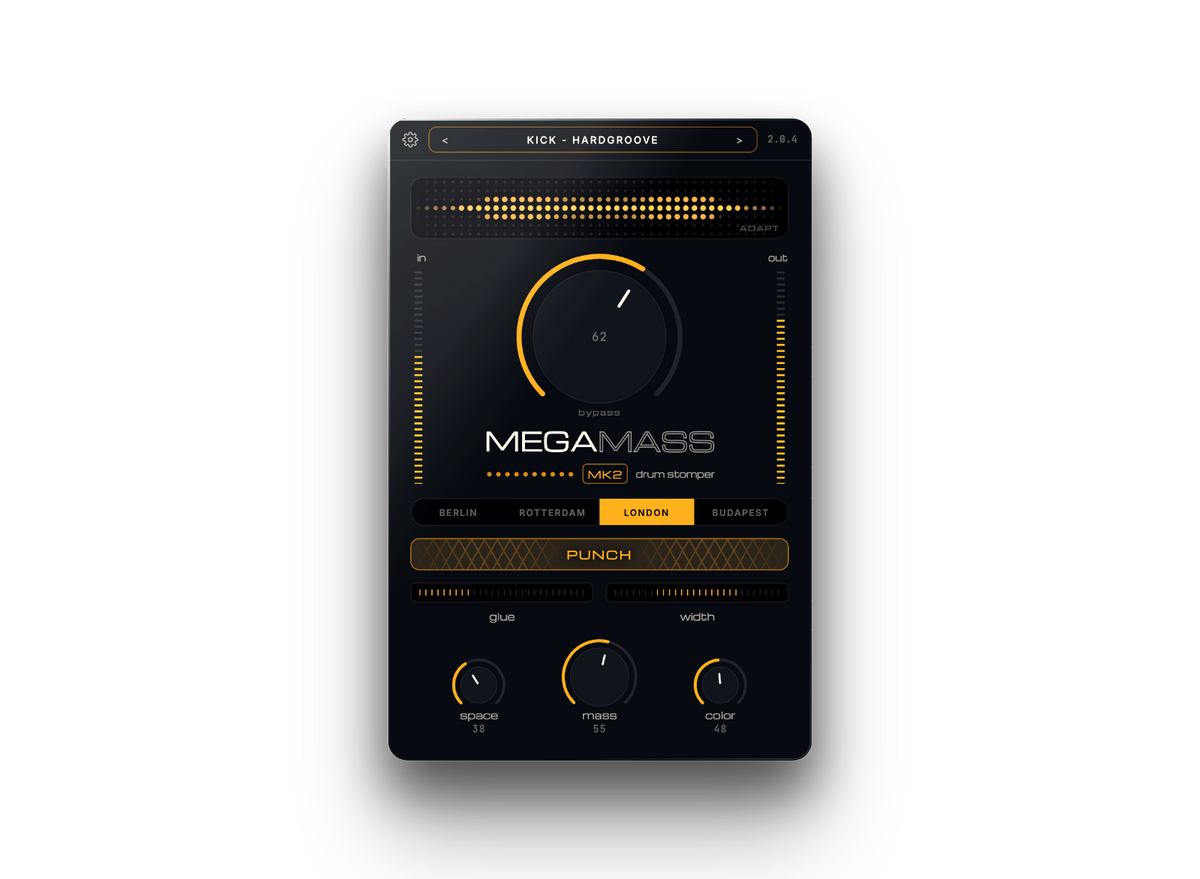
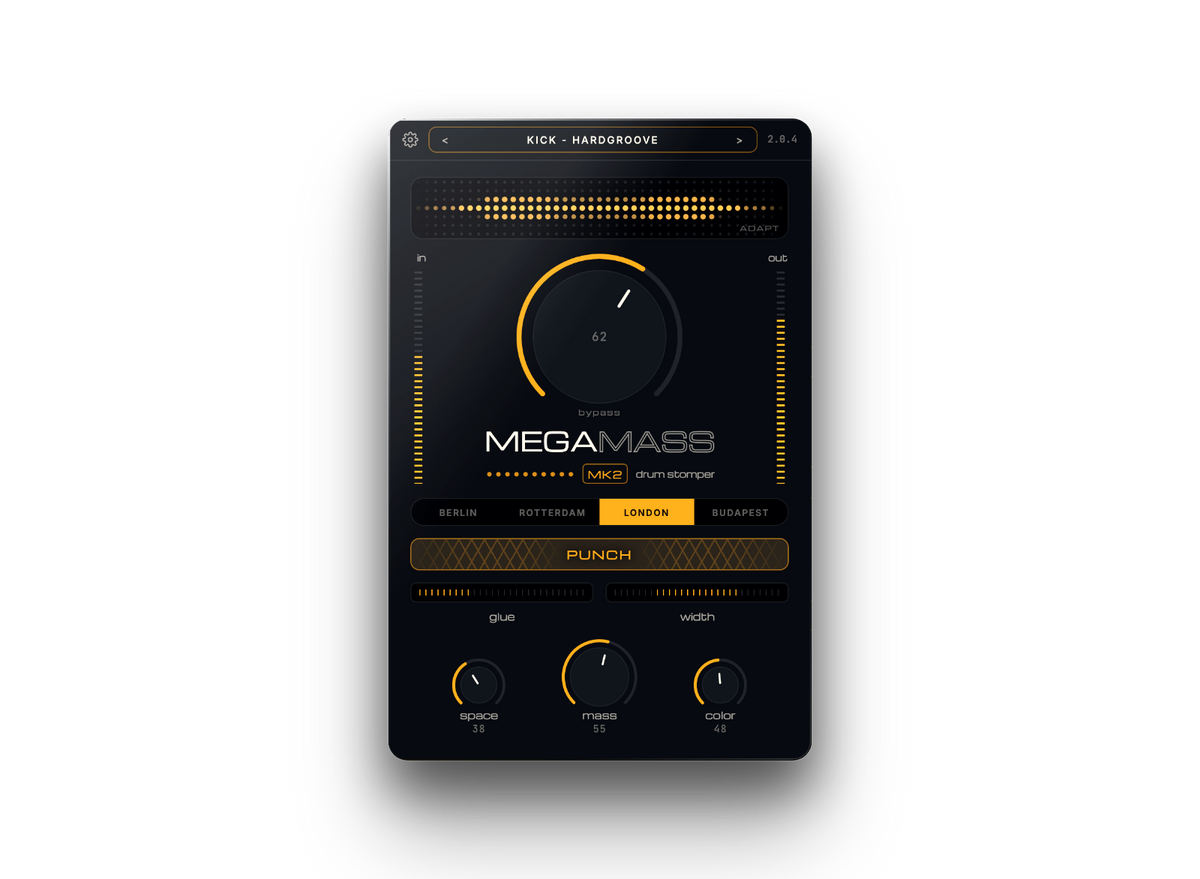
Tips 4 to 6 usually mean 3 or 4 plugins and a lot of A/B. Megamass MK2 is our kick and drum processor built to add weight, punch and depth in one move. A quick workflow:
- Load it on the kick channel, after tuning and EQ.
- Press Adapt. It sets Mass, Space and Color for the kick you are running through it, so you start from a balanced point instead of a blank page.
- Press Punch if the kick needs more bite in a busy mix.
- Audition the 4 city modes (Berlin, Rotterdam, London and Budapest). Each is a different character of distortion, so pick the one that suits the genre and the sample.
- Gain-match with the bypass and keep only what actually helps.
It also ships with the Kick Essentials DLC (100 kicks and 20 artist presets), handy if tip 1 shows your current sample is fighting the track. It runs as VST3, AU and AAX on Mac (Apple Silicon and Intel) and Windows.
Common mistakes
- Boosting 50 Hz to fix a weak kick. It eats headroom and often makes the low end muddier. Fix the space first, then add harmonics.
- Layering 3 kicks without checking phase. Layers with different low ends can cancel each other. Keep one kick for the sub and high-pass the others.
- Soloing the kick for too long. A kick that sounds perfect solo can vanish in the mix. Do most of the work with the full track playing.
- Heavy limiting on the master to get loudness. The limiter hits the kick first, so the loudest part of the track gets squashed the most.
For the bigger picture on drum sound design, read Designing Drums in Modern Electronic Music.
FAQ
What frequency makes a kick punchy?
Punch comes from 2 areas: the body around 50 to 100 Hz and the attack around 2 to 5 kHz. The low area gives weight, the high area makes the hit audible in a busy mix. Most kicks that feel weak are missing the attack, not the low end.
Should I compress my kick?
Often you do not need to. A well-chosen sample is already consistent. If you compress, use a slower attack of 10 to 30 ms so the transient passes through, and aim for 2 to 3 dB of gain reduction.
Why does my kick sound good in headphones but weak on a phone?
Phone speakers barely play anything below 100 Hz, so a kick built mostly from sub disappears. Add saturation so the kick has harmonics above 100 Hz, and check the mix on a phone before you call it done.
Should the kick be in mono?
Yes. Keep the kick and everything below about 120 Hz in mono. It hits harder, translates better to clubs and mono speakers, and avoids phase problems on vinyl and streaming.
Want weight, punch and depth on your kick without building a 4-plugin chain? Try Megamass MK2.


Leave a comment
This site is protected by hCaptcha and the hCaptcha Privacy Policy and Terms of Service apply.